Showing posts with label Corporal Crossingham. Show all posts

Monday, December 1, 2014

Military Monday - Treasures from Aunty Glad's Suitcase - Gibraltar to arrival at Lark Hill Salisbury Plains

The 30th and 34th Battalion's stay at Gibraltar was short lived, and their ship soon made its way to England.  The rest of their trip was quite uneventful until finally after nearly eight weeks at sea the troops arrived in Plymouth Harbour.  England at last!

My grandfather Malcolm Michael Shepherd and his fellow troops were quickly loaded onto a trains and taken to their camp at Lark Hill near the village of Salisbury.  Aunty Glad's suitcase holds a number of post cards depicting the countryside near Lark Hill.  I will let Corporal Crossingham, complete the story of their arrival and settling into camp with the last part of his letter.


The final section of Corporal Crossingham's letter continues: 

"We stayed at Gibraltar about two and a half hours, then we weighed anchor and off again around the Bay of Biscay.  For some reason or other we did not go straight through. From now until the 21st of June nothing happened of interest.
Postcard of Gilbraltar from Aunty Glad's Suitcase

June 21
Passed Eddystone Lighthouse and were very interested watching drifters (fishing boats) at work, and scanning the distant shores of England.  At 11.a.m. the sound of the anchor dropping brought all hands on deck at the double to find themselves in Plymouth Harbour.  One can imagine the excitement that reigned when we were ordered to get ready to land at once.  We were anchored out in midstream, and were disembarked on the Sir Walter Raleigh, from which we were transferred to land. It was great to get to shore after being couped up on board for nearly eight weeks.

We were all lined up with our kit bags on our shoulders and marched to the train.  There was nothing to growl at as regards the travelling accommodation.  We were put into third class carriages, which to my mind are equal if not better than Australian second-class and were allowed a fair amount of room, only eight men being put into each compartment.  Leaving the station we passed some very pretty scenery.  The country was looking at its best.  One has only to get into his mind’s eye an old fashioned farmhouse, with a thatched roof and white washed walls, surrounded by trees and shrubs, with nice green fields, dotted with poppies and buttercups, and each little farm was surrounded with dark green hedges. There are no fences, with a well-kept road or drive running up to the door.  This will give some idea of what we saw.
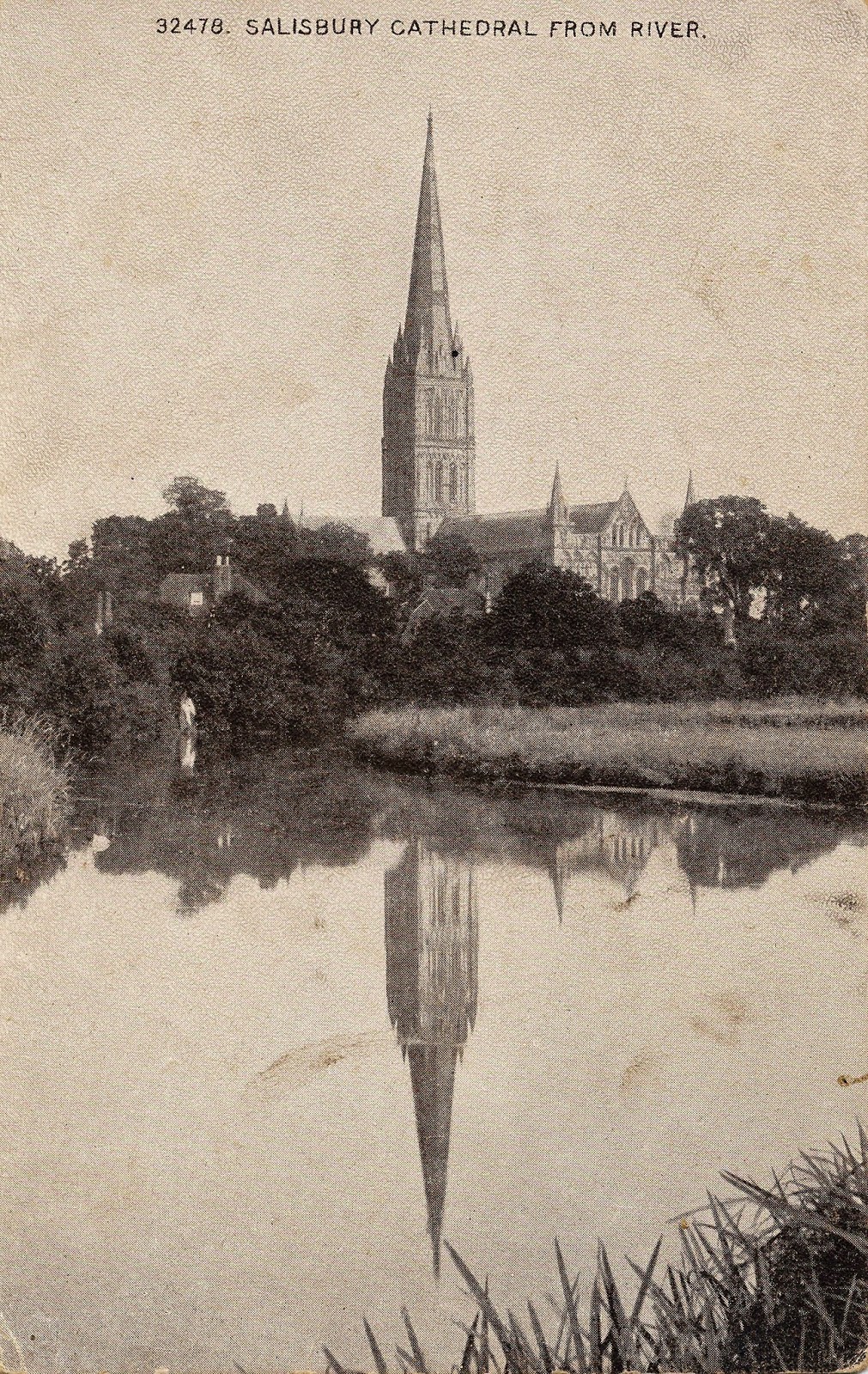
Postcard of Church in Salisbury

At nearly every village we passed the people were gathered in groups, waving and cheering as if they were welcoming us back from some victorious battle, while in reality we were only coming in to be trained.

The friendly manner in which the home people treated us went a long way towards making us forget what we had left behind, and made us feel at home, and I can safely say that all our boys appreciated their kind thoughts and actions.  They think a lot of the Australians. 

Our first stop was Exeter, about 50 miles from Plymouth, where another welcome surprise waited us.  As soon as the train stopped every man jack made a bold bid for the refreshment room, but were stopped by our officers, who told us to get what we wanted from the stalls that were distributed along the platform.  Then there was a rush back to our carriages to get our water bottles, which were then filled with nice hot tea.  Each man was then handed a paper-bag with buns and cakes in it.  Also a card from the Mayoress of Exeter and committee, wishing us all good luck.

That was about the most pleasant surprise up till now that we had have had.  Leaving Exeter we continued our journey arriving at Amesbury at 10 minutes past twilight.  On detraining we were formed up and marched to No. 1 Camp, Lark Hill, Salisbury Plain, arriving there at 12.15 p.m.   After being told off to our respective huts we were issued with bully beef and biscuits.  It was a rough and ready feed, but we all enjoyed it, after which we settled down for a few hours rest.  We were up about 7.a.m. next morning, and out taking bearings of our new surroundings, which we soon picked up.
 
Postcard - Lark Hill Training Camp
The first place we found was the Y.M.C.A. refreshment hut, and we quite surprised the attendants with the orders that we give for breakfast.  They were quite amused to watch us having an ordinary meal, which they thought was quite enough for four of five Tommies. Coming back from the Y.M.C.A. we turned to and made our sleeping quarters as comfortable as possible.  Next day being Sunday most of the boys went for a tour of inspection round the villages, where we found many item to interest us.  We hope to have another look round later on, but for the present we have to go to hard graft, and get ourselves fit for the job that we came over to do.  We recognise since speaking to thousands that have come back from the frond what a task it is, but complete victory we want and complete victory we are sure to get, cost what it may.”*


Card sent back from Malcolm Shepherd  to his family from Salisbury, the village near Lark Hill where he was stationed.

____________
*1916 'BOYS OF THE 34th.', The Maitland Weekly Mercury(NSW : 1894 - 1931), 30 December, p. 10, viewed 16 November, 2014,http://nla.gov.au/nla.news-article128039051


Monday, November 24, 2014

Military Monday - More Treasures from Aunty Glad's Suitcase

Aunty Glad's Suitcase
This blog continues on with the story of Malcolm Micheal Shepherd's journey with the 30th and 34th Battalion on the ship Hororata, from Sydney to England, told through they eyes of Corporal Crossingham and illustrated with pictures and postcards from Aunty Glad's Suitcase.

Corporal Crossingham continues with his dry humour, describing visiting the different ports, the joys of being able to buy fresh fruit, along with tales of some very dubious meals on board the ship. As his story continues, you begin to feel a little of their sense of uneasiness of what lies in the future for them, their relief at not being based in the dessert and the impact of their first sight of Gilbralta.

Continuing Corporal Crossingham's Story:

"May 24 –Arrived at Colombo and here we were allowed to go ashore.  Had a route march, and were taken out to the Garrison Barracks where we could purchase any amount of fruit at reasonable prices.  Pineapples only cost 3d a piece, coconuts 3 for 6d, bananas, 1 /- per bunch of anything from 50 t up to 100.  The Y.M.C.A. had a refreshment stall there where one could get cakes 1d each, soft drinks 2d, tea, coffee or cocoa 1d per pot, cold boiled eggs 1d each, and sandwiches 2d. 

 We were allowed to have one beer there, and to make sure we go no more we were issued with tickets which cost 3d without which we were not supposed to get a drink at all, but the boys soon found out that “where there’s a will there’s a way”, with the result that we all had a merry time.  It was very interesting to watch the coolies at work.  They will do almost anything for money.  They are very good workers, and especially when there is a rope end handy.  It was very laughable to watch them having their meals, which consisted of boiled rice with liquid curry poured over it, served out to them on palm leaves, cut into small squares about 12 inches by 12 inches.  Once a day they get a banana as an extra.
Malcolm Shepherd (LHS) and fellow soldiers


May 26 – Left Colombo, when the coolies became very excited, and shouted “good-bye” till they were quite hoarse.

June 1 – Great excitement caused by the announcement that there was a plum duff for dinner  But the shock when it came, I am quite satisfied all our boys do not suffer with a weak heart.  A man dare not show his head above the edge of the table for fear he would draw the fire on himself and when the pieces began to fly they rattled on the ship’s side like bottles breaking on a brick wall.  Someone suggested praying for it, but he was ruled out of order, as we decided it was past redemption

June 3 – Sunday morning. Attended church parade.  Sighted land at noon.  Passed the Bay of Aden on the Arabian Coast on the starboard side and the African Coast on the port. Great interest was shown by the boys watching thousands of porpoises playing about Aden.

June 4 – Sighted a small town called Monkka, which, I was told, was famous for coffee making.

June 5 – passed the Twelve Apostles which is a group of 12 rocks rising up out of the sea.

June 8 – Caught our first glimpse of the much talked of Egypt at 8 a.m.

June 9 – Anchored in Port Suez. At 2 p.m. weighed anchor and entered Suez Canal.  I am told that all troops that came over before us were allowed ashore to strength their legs, but for some reason or other we were not allowed to do so.  It was very interesting going through the Canal.  It is well guarded day and night.  Here and there in isolated spots one can see a small patch of grass struggling for life, or else a few reeds growing on the edge of the canal.  With that exception all one could see was one long strength of sand, white and glistening with camps of troops dotted here and there over the desert.  No one was more pleased that I when we were told that we had to proceed to Alexandria.  The sight of that vast stretch of sand and the temperature was quite sufficient for me.  All the boys who had the bad luck to be stationed there have the sympathy of every one on board our boat.  The Canal is reckoned to be 34 miles long and takes 16 hours to do a trip through, as boats are not allowed to travel any faster than 5 miles per hour on account of the was doing damage to the banks.  Leaving the Canal we came along to Port Said, arriving there about 7.30 am. Port Said presents a very busy scene by what one can see from the boat.  It is a hurry and scurry, small pleasure boats rowing about everywhere.

June 11 – Leaving Port Said we went on to Alexandria.  As soon as we left Port we were ordered to don life belts and were never without them till we arrived at Plymouth.  They were worn all day, and even slept in them.  It was a very queer sensation to wake up the first morning and find a life belt hanging to one’s neck by a piece of tape.  It made one feel as if one had been having a night out, and did not remember what had taken place before retiring.

June 12 – Arrived in Alexandria, which looks similar to Port Said, the only difference being that the buildings do not seem to be so close together, and it is cleaner in appearances.  We were now formed up and marched off the Hororata and around to the Aragon, which had been waiting for us for some days.  There were already about 700 troops on board from Egypt.  When on board the Hororata we were praying for a change of boats.  But what a change it was when we did get it.  We simply wished we were back on board the old home once more.  For we were out of the frying pan into the fire.  We were packed like sardines in a tine and no room for all at that.  It was a good job for us that we did not have a very long time to put in before getting to our journey’s end.  It was very seldom that we got bread that was not sour, and not too much of it either.  The Aragon is a fine boat in appearance, but for tucker and accommodation it has a lot to pull up.  We left Alexandria on the 13th.

June 14 – Passed the Island of Crete at 2 a.m when we were picked up by a new escort.

June 15 – Passed along the coast of Greece following in the wake of our escort.

June 17 – Arrived at the great fortified rock, Gibraltar.  One has only to glance at with its guns bristling from every nook and crevice, and it will be realized what an impregnable barrier it really forms.  Coming in from the sea all one can see is a great bare rock rising up out of the sea with a few guns mounted here and there.  But when the boat comes around the Rock to the entrance and one gets a rear view it downs on one that there is danger behind that great rugged rock." *

Post Card from Aunty Glad's suitcase - Gibraltar

This must have been a formidable sight to the young Malcolm Michael Shepherd, the young "carrier" from the small country town of Braidwood.  You can only imagine the feeling of the unknown and foreboding these young soldiers were experiencing.  

_____________
 *1916 'BOYS OF THE 34th.', The Maitland Weekly Mercury(NSW : 1894 - 1931), 30 December, p. 10, viewed 16 November, 2014,http://nla.gov.au/nla.news-article128039051