.jpg)
The 30th and 34th Battalion's stay at Gibraltar was short lived, and their ship soon made its way to England. The rest of their trip was quite uneventful until finally after nearly eight weeks at sea the troops arrived in Plymouth Harbour. England at last!
My grandfather Malcolm Michael Shepherd and his fellow troops were quickly loaded onto a trains and taken to their camp at Lark Hill near the village of Salisbury. Aunty Glad's suitcase holds a number of post cards depicting the countryside near Lark Hill. I will let Corporal Crossingham, complete the story of their arrival and settling into camp with the last part of his letter.
The final section of Corporal Crossingham's letter continues:
"We stayed at Gibraltar about two and a half hours, then we
weighed anchor and off again around the Bay of Biscay. For some reason or other we did not go straight
through. From now until the 21st of June nothing happened of
interest.
 |
| Postcard of Gilbraltar from Aunty Glad's Suitcase |
June 21
Passed Eddystone Lighthouse and were very interested
watching drifters (fishing boats) at work, and scanning the distant shores of
England. At 11.a.m. the sound of the
anchor dropping brought all hands on deck at the double to find themselves in
Plymouth Harbour. One can imagine the
excitement that reigned when we were ordered to get ready to land at once. We were anchored out in midstream, and were
disembarked on the Sir Walter Raleigh, from which we were transferred to land.
It was great to get to shore after being couped up on board for nearly eight
weeks.
We were all lined up
with our kit bags on our shoulders and marched to the train. There was nothing to growl at as regards the
travelling accommodation. We were put
into third class carriages, which to my mind are equal if not better than
Australian second-class and were allowed a fair amount of room, only eight men
being put into each compartment. Leaving
the station we passed some very pretty scenery.
The country was looking at its best.
One has only to get into his mind’s eye an old fashioned farmhouse, with
a thatched roof and white washed walls, surrounded by trees and shrubs, with
nice green fields, dotted with poppies and buttercups, and each little farm was
surrounded with dark green hedges. There are no fences, with a well-kept road
or drive running up to the door. This
will give some idea of what we saw.
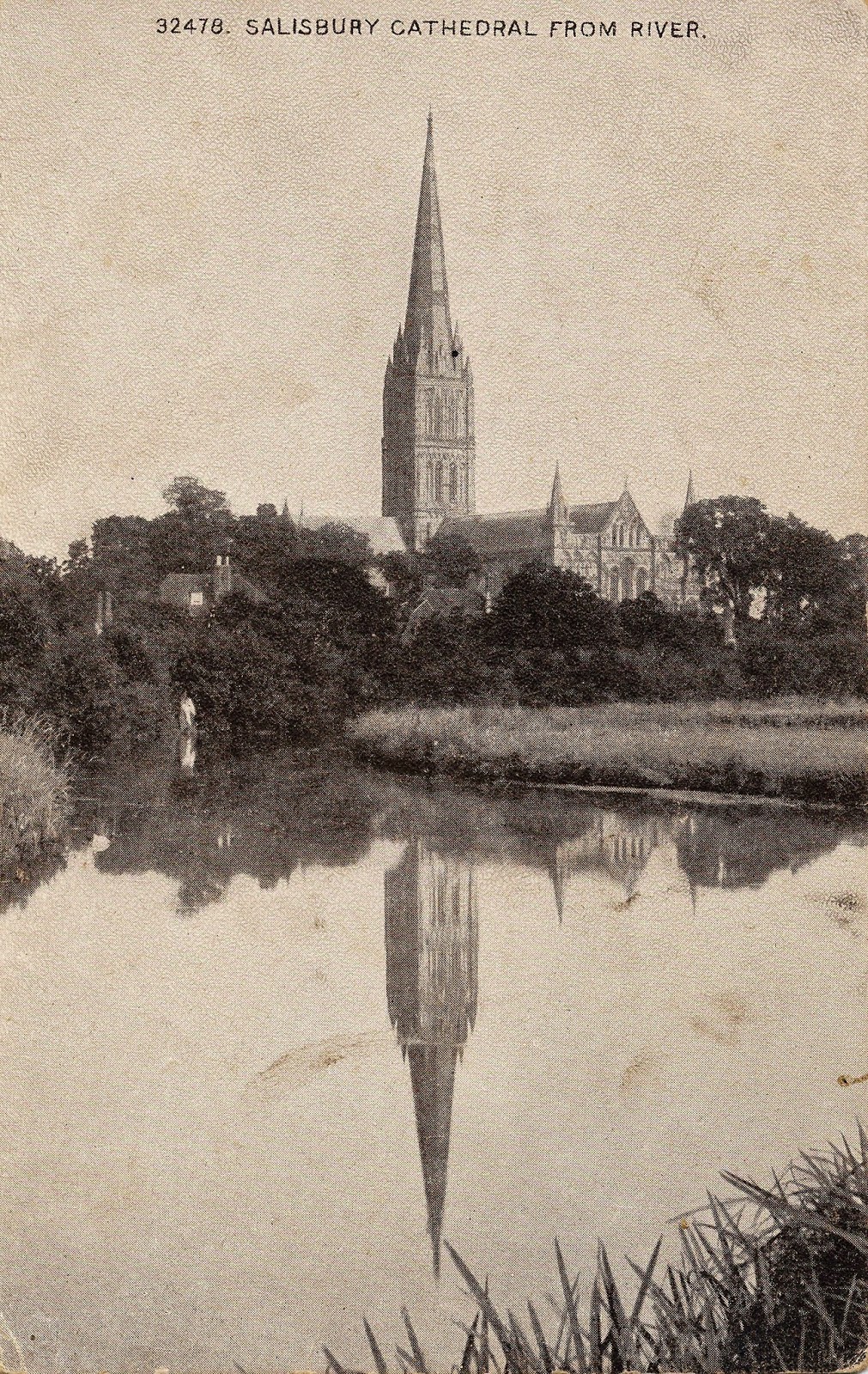 |
| Postcard of Church in Salisbury |
At nearly every village we passed the people were gathered
in groups, waving and cheering as if they were welcoming us back from some
victorious battle, while in reality we were only coming in to be trained.
The friendly manner in which the home people
treated us went a long way towards making us forget what we had left behind,
and made us feel at home, and I can safely say that all our boys appreciated
their kind thoughts and actions. They
think a lot of the Australians.
Our
first stop was Exeter, about 50 miles from Plymouth, where another welcome
surprise waited us. As soon as the train
stopped every man jack made a bold bid for the refreshment room, but were
stopped by our officers, who told us to get what we wanted from the stalls that
were distributed along the platform.
Then there was a rush back to our carriages to get our water bottles,
which were then filled with nice hot tea.
Each man was then handed a paper-bag with buns and cakes in it. Also a card from the Mayoress of Exeter and
committee, wishing us all good luck.
That was about the most pleasant surprise up till now that
we had have had. Leaving Exeter we
continued our journey arriving at Amesbury at 10 minutes past twilight. On detraining we were formed up and marched
to No. 1 Camp, Lark Hill, Salisbury Plain, arriving there at 12.15 p.m. After being told off to our respective huts
we were issued with bully beef and biscuits.
It was a rough and ready feed, but we all enjoyed it, after which we settled
down for a few hours rest. We were up
about 7.a.m. next morning, and out taking bearings of our new surroundings,
which we soon picked up.
 |
| Postcard - Lark Hill Training Camp |
The first place we found was the Y.M.C.A. refreshment hut,
and we quite surprised the attendants with the orders that we give for
breakfast. They were quite amused to
watch us having an ordinary meal, which they thought was quite enough for four
of five Tommies. Coming back from the Y.M.C.A. we turned to and made our
sleeping quarters as comfortable as possible.
Next day being Sunday most of the boys went for a tour of inspection round
the villages, where we found many item to interest us. We hope to have another look round later on,
but for the present we have to go to hard graft, and get ourselves fit for the
job that we came over to do. We recognise
since speaking to thousands that have come back from the frond what a task it
is, but complete victory we want and complete victory we are sure to get, cost
what it may.”*

 |
| Card sent back from Malcolm Shepherd to his family from Salisbury, the village near Lark Hill where he was stationed. |
____________
*1916 'BOYS OF THE 34th.', The Maitland Weekly Mercury(NSW : 1894 - 1931), 30 December, p. 10, viewed 16 November, 2014,http://nla.gov.au/nla.news-article128039051


