Showing posts with label Malcolm Michael Shepherd. Show all posts

Thursday, May 14, 2015

Wordless Wednesday - Shepherd Siblings


This is a picture of my father Malcolm Lloyd Shepherd and his siblings Nancy and Colin, which was probably taken about 1932. Their parents were Christina Sterland Lee and Malcolm Michael Shepherd.  Unfortunately, their father, Mac, died in 1932 as a result of injuries he received in a logging accident.  As I look at this picture, I wonder if it was taken before or after the death of their father. 

Thursday, April 16, 2015

Almost "Wordless Wednesday" - another Treasure from Aunty Glad's Suitcase

It is time to rummage in Aunty Glad's Suitcase again!  

Today's discovery is a post card from Malcolm Michael Shepherd to his brother Angus.

The card was posted on Thursday 10th June 1916, Telelekebir and would have been posted from Port Suez, when Malcolm was travelling through to England on the Hororata with his Battalion (7th Reinforcement of the 30th Battalion) to England.  The 10th of June 1916 was the day his Battalion, would have received the news that they were proceeding on to Alexandria.  See below a short extract from my recent post on Malcolm's journey from Australia to England. 

"June 9 – Anchored in Port Suez. At 2 p.m. weighed anchor and entered Suez Canal.  I am told that all troops that came over before us were allowed ashore to strength their legs, but for some reason or other we were not allowed to do so.  It was very interesting going through the Canal.  It is well guarded day and night.  Here and there in isolated spots one can see a small patch of grass struggling for life, or else a few reeds growing on the edge of the canal.  With that exception all one could see was one long strength of sand, white and glistening with camps of troops dotted here and there over the desert.  No one was more pleased that I when we were told that we had to proceed to Alexandria.  The sight of that vast stretch of sand and the temperature was quite sufficient for me.  All the boys who had the bad luck to be stationed there have the sympathy of every one on board our boat.  The Canal is reckoned to be 34 miles long and takes 16 hours to do a trip through, as boats are not allowed to travel any faster than 5 miles per hour on account of the was doing damage to the banks.  Leaving the Canal we came along to Port Said, arriving there about 7.30 am. Port Said presents a very busy scene by what one can see from the boat.  It is a hurry and scurry, small pleasure boats rowing about everywhere.

June 11 – Leaving Port Said we went on to Alexandria.  As soon as we left Port we were ordered to don life belts and were never without them till we arrived at Plymouth.  They were worn all day, and even slept in them.  It was a very queer sensation to wake up the first morning and find a life belt hanging to one’s neck by a piece of tape.  It made one feel as if one had been having a night out, and did not remember what had taken place before retiring."

Telelekebir, is about 110 kms north east of Cairo. Malcolm reports that one of his friends, Tom Garratt, has been taken to hospital in Cairo, as he had been sick for over a week. 

The picture on the front of the card is of the Heliopolis Palace, is now one of the three royal palaces in Cairo. It was built in 1910 as a grand Hotel.  This grand hotel would have certainly made an impression on the young soldier from the small southern highland village of Braidwood, NSW.

Back of Post Card sent home from Suez

Front of Post Card sent by Malcolm Michael Shepherd from Suez.

Once again, I have to count my blessings, and thank Aunty Glad for having the forethought to save all these wonderful family memories, that give such meaning to our family stories.

Sunday, March 8, 2015

Military Monday - Treasures from Aunty Glad's Suitcase - Postcards from WWI

Aunty Glad's Suitcase
Among the many treasures found in Aunty Glad's Suitcase is a wonderful collection of old postcards sent back to Australia by Angus and Malcolm Shepherd.

Each card has a unique story, as does the one I am sharing with you today.  Often the card's uniqueness comes from the message on the back, however, today's card's story comes from the verse and credit written at the bottom of the card.

The Song "It's a long way to Tipperary"  was a popular song sung by the soldiers during WWI. It seems that "A long way to Tipperary"  quickly became a favorite with the "Tommies",  It is interesting that at the bottom of the card there is a reference that the words to the song were printed with the permission of B. Feldman and Co, 2 and 3 Arthur Street London.  The words of the song are credited to Jack Jude and Harry Williams, with the Copyright belong to B. Feldman and Co.


Postcard from WWI

Wednesday, January 21, 2015

Treasure Chest Thursday - from Aunty Glad's Suitcase - WW1 Field Card

It is time to dig into Aunty Glad's suitcase for some more WWI history.

Among the collection of WWI post cards from Angus Shepherd and Malcolm Michael Shepherd I found one that intrigued me.  This was what you would call a "fill in the gaps" post card.  i.e. the card had a number of messages on the back which the sender could cross out and keep the appropriate message.  Handy I thought, something today's post card printers should consider for the traveler who wants to send a message home with the minimum of effort.

However, with this post card this was not the case.  The card, from Angus, was sent to his mother Mrs Lynn Shepherd from somewhere in Europe on the 4th October 1817.  You will note that instructions on the front of the card state that the only thing to be written on the front of the card is the address and "If anything else is added the post card will be destroyed"! 


Field post cards were an early form of censorship that were designed for troops to send home.  The message from the soldier was compiled by crossing out the irrelevant lines, they were not permitted to write any additional information other than their signature and the date.


Soldiers were not allowed to disclose their whereabouts, and I am sure many soldiers were glad to be able to send their family a simple greeting, without having to disclose the reality of their life in the battle field. 

These post cards served a number of purposes.  Not only did they provide their loved ones at home with the knowledge that they were still alive but also gave the soldiers something to do.  Boredom was an issue for the soldiers in the field and writing was one of the few activities that they were able to do and provided them with some distraction from the horrors of war. 

Playing a part in the War propaganda, the Field Cards not only delivering those at home with news of their loved ones in the forces but also helped to sustain the popularity of the war effort on the home front and protecting families from the reality of the Australian War effort in Europe and North Africa.

Monday, December 1, 2014

Military Monday - Treasures from Aunty Glad's Suitcase - Gibraltar to arrival at Lark Hill Salisbury Plains

The 30th and 34th Battalion's stay at Gibraltar was short lived, and their ship soon made its way to England.  The rest of their trip was quite uneventful until finally after nearly eight weeks at sea the troops arrived in Plymouth Harbour.  England at last!

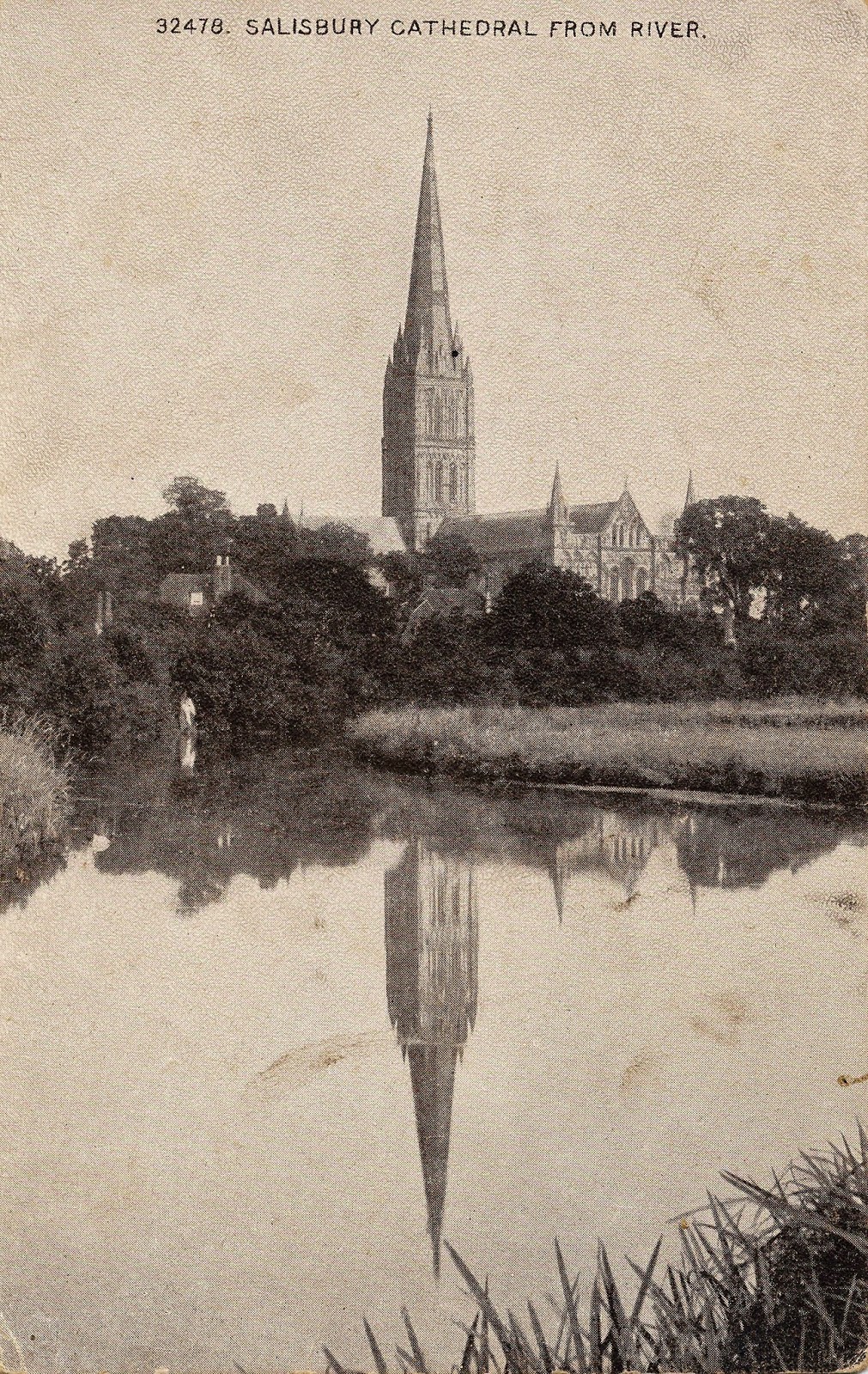
My grandfather Malcolm Michael Shepherd and his fellow troops were quickly loaded onto a trains and taken to their camp at Lark Hill near the village of Salisbury.  Aunty Glad's suitcase holds a number of post cards depicting the countryside near Lark Hill.  I will let Corporal Crossingham, complete the story of their arrival and settling into camp with the last part of his letter.


The final section of Corporal Crossingham's letter continues: 

"We stayed at Gibraltar about two and a half hours, then we weighed anchor and off again around the Bay of Biscay.  For some reason or other we did not go straight through. From now until the 21st of June nothing happened of interest.
Postcard of Gilbraltar from Aunty Glad's Suitcase

June 21
Passed Eddystone Lighthouse and were very interested watching drifters (fishing boats) at work, and scanning the distant shores of England.  At 11.a.m. the sound of the anchor dropping brought all hands on deck at the double to find themselves in Plymouth Harbour.  One can imagine the excitement that reigned when we were ordered to get ready to land at once.  We were anchored out in midstream, and were disembarked on the Sir Walter Raleigh, from which we were transferred to land. It was great to get to shore after being couped up on board for nearly eight weeks.

We were all lined up with our kit bags on our shoulders and marched to the train.  There was nothing to growl at as regards the travelling accommodation.  We were put into third class carriages, which to my mind are equal if not better than Australian second-class and were allowed a fair amount of room, only eight men being put into each compartment.  Leaving the station we passed some very pretty scenery.  The country was looking at its best.  One has only to get into his mind’s eye an old fashioned farmhouse, with a thatched roof and white washed walls, surrounded by trees and shrubs, with nice green fields, dotted with poppies and buttercups, and each little farm was surrounded with dark green hedges. There are no fences, with a well-kept road or drive running up to the door.  This will give some idea of what we saw.
Postcard of Church in Salisbury

At nearly every village we passed the people were gathered in groups, waving and cheering as if they were welcoming us back from some victorious battle, while in reality we were only coming in to be trained.

The friendly manner in which the home people treated us went a long way towards making us forget what we had left behind, and made us feel at home, and I can safely say that all our boys appreciated their kind thoughts and actions.  They think a lot of the Australians. 

Our first stop was Exeter, about 50 miles from Plymouth, where another welcome surprise waited us.  As soon as the train stopped every man jack made a bold bid for the refreshment room, but were stopped by our officers, who told us to get what we wanted from the stalls that were distributed along the platform.  Then there was a rush back to our carriages to get our water bottles, which were then filled with nice hot tea.  Each man was then handed a paper-bag with buns and cakes in it.  Also a card from the Mayoress of Exeter and committee, wishing us all good luck.

That was about the most pleasant surprise up till now that we had have had.  Leaving Exeter we continued our journey arriving at Amesbury at 10 minutes past twilight.  On detraining we were formed up and marched to No. 1 Camp, Lark Hill, Salisbury Plain, arriving there at 12.15 p.m.   After being told off to our respective huts we were issued with bully beef and biscuits.  It was a rough and ready feed, but we all enjoyed it, after which we settled down for a few hours rest.  We were up about 7.a.m. next morning, and out taking bearings of our new surroundings, which we soon picked up.
 
Postcard - Lark Hill Training Camp
The first place we found was the Y.M.C.A. refreshment hut, and we quite surprised the attendants with the orders that we give for breakfast.  They were quite amused to watch us having an ordinary meal, which they thought was quite enough for four of five Tommies. Coming back from the Y.M.C.A. we turned to and made our sleeping quarters as comfortable as possible.  Next day being Sunday most of the boys went for a tour of inspection round the villages, where we found many item to interest us.  We hope to have another look round later on, but for the present we have to go to hard graft, and get ourselves fit for the job that we came over to do.  We recognise since speaking to thousands that have come back from the frond what a task it is, but complete victory we want and complete victory we are sure to get, cost what it may.”*


Card sent back from Malcolm Shepherd  to his family from Salisbury, the village near Lark Hill where he was stationed.

____________
*1916 'BOYS OF THE 34th.', The Maitland Weekly Mercury(NSW : 1894 - 1931), 30 December, p. 10, viewed 16 November, 2014,http://nla.gov.au/nla.news-article128039051


Monday, November 24, 2014

Military Monday - More Treasures from Aunty Glad's Suitcase

Aunty Glad's Suitcase
This blog continues on with the story of Malcolm Micheal Shepherd's journey with the 30th and 34th Battalion on the ship Hororata, from Sydney to England, told through they eyes of Corporal Crossingham and illustrated with pictures and postcards from Aunty Glad's Suitcase.

Corporal Crossingham continues with his dry humour, describing visiting the different ports, the joys of being able to buy fresh fruit, along with tales of some very dubious meals on board the ship. As his story continues, you begin to feel a little of their sense of uneasiness of what lies in the future for them, their relief at not being based in the dessert and the impact of their first sight of Gilbralta.

Continuing Corporal Crossingham's Story:

"May 24 –Arrived at Colombo and here we were allowed to go ashore.  Had a route march, and were taken out to the Garrison Barracks where we could purchase any amount of fruit at reasonable prices.  Pineapples only cost 3d a piece, coconuts 3 for 6d, bananas, 1 /- per bunch of anything from 50 t up to 100.  The Y.M.C.A. had a refreshment stall there where one could get cakes 1d each, soft drinks 2d, tea, coffee or cocoa 1d per pot, cold boiled eggs 1d each, and sandwiches 2d. 

 We were allowed to have one beer there, and to make sure we go no more we were issued with tickets which cost 3d without which we were not supposed to get a drink at all, but the boys soon found out that “where there’s a will there’s a way”, with the result that we all had a merry time.  It was very interesting to watch the coolies at work.  They will do almost anything for money.  They are very good workers, and especially when there is a rope end handy.  It was very laughable to watch them having their meals, which consisted of boiled rice with liquid curry poured over it, served out to them on palm leaves, cut into small squares about 12 inches by 12 inches.  Once a day they get a banana as an extra.
Malcolm Shepherd (LHS) and fellow soldiers


May 26 – Left Colombo, when the coolies became very excited, and shouted “good-bye” till they were quite hoarse.

June 1 – Great excitement caused by the announcement that there was a plum duff for dinner  But the shock when it came, I am quite satisfied all our boys do not suffer with a weak heart.  A man dare not show his head above the edge of the table for fear he would draw the fire on himself and when the pieces began to fly they rattled on the ship’s side like bottles breaking on a brick wall.  Someone suggested praying for it, but he was ruled out of order, as we decided it was past redemption

June 3 – Sunday morning. Attended church parade.  Sighted land at noon.  Passed the Bay of Aden on the Arabian Coast on the starboard side and the African Coast on the port. Great interest was shown by the boys watching thousands of porpoises playing about Aden.

June 4 – Sighted a small town called Monkka, which, I was told, was famous for coffee making.

June 5 – passed the Twelve Apostles which is a group of 12 rocks rising up out of the sea.

June 8 – Caught our first glimpse of the much talked of Egypt at 8 a.m.

June 9 – Anchored in Port Suez. At 2 p.m. weighed anchor and entered Suez Canal.  I am told that all troops that came over before us were allowed ashore to strength their legs, but for some reason or other we were not allowed to do so.  It was very interesting going through the Canal.  It is well guarded day and night.  Here and there in isolated spots one can see a small patch of grass struggling for life, or else a few reeds growing on the edge of the canal.  With that exception all one could see was one long strength of sand, white and glistening with camps of troops dotted here and there over the desert.  No one was more pleased that I when we were told that we had to proceed to Alexandria.  The sight of that vast stretch of sand and the temperature was quite sufficient for me.  All the boys who had the bad luck to be stationed there have the sympathy of every one on board our boat.  The Canal is reckoned to be 34 miles long and takes 16 hours to do a trip through, as boats are not allowed to travel any faster than 5 miles per hour on account of the was doing damage to the banks.  Leaving the Canal we came along to Port Said, arriving there about 7.30 am. Port Said presents a very busy scene by what one can see from the boat.  It is a hurry and scurry, small pleasure boats rowing about everywhere.

June 11 – Leaving Port Said we went on to Alexandria.  As soon as we left Port we were ordered to don life belts and were never without them till we arrived at Plymouth.  They were worn all day, and even slept in them.  It was a very queer sensation to wake up the first morning and find a life belt hanging to one’s neck by a piece of tape.  It made one feel as if one had been having a night out, and did not remember what had taken place before retiring.

June 12 – Arrived in Alexandria, which looks similar to Port Said, the only difference being that the buildings do not seem to be so close together, and it is cleaner in appearances.  We were now formed up and marched off the Hororata and around to the Aragon, which had been waiting for us for some days.  There were already about 700 troops on board from Egypt.  When on board the Hororata we were praying for a change of boats.  But what a change it was when we did get it.  We simply wished we were back on board the old home once more.  For we were out of the frying pan into the fire.  We were packed like sardines in a tine and no room for all at that.  It was a good job for us that we did not have a very long time to put in before getting to our journey’s end.  It was very seldom that we got bread that was not sour, and not too much of it either.  The Aragon is a fine boat in appearance, but for tucker and accommodation it has a lot to pull up.  We left Alexandria on the 13th.

June 14 – Passed the Island of Crete at 2 a.m when we were picked up by a new escort.

June 15 – Passed along the coast of Greece following in the wake of our escort.

June 17 – Arrived at the great fortified rock, Gibraltar.  One has only to glance at with its guns bristling from every nook and crevice, and it will be realized what an impregnable barrier it really forms.  Coming in from the sea all one can see is a great bare rock rising up out of the sea with a few guns mounted here and there.  But when the boat comes around the Rock to the entrance and one gets a rear view it downs on one that there is danger behind that great rugged rock." *

Post Card from Aunty Glad's suitcase - Gibraltar

This must have been a formidable sight to the young Malcolm Michael Shepherd, the young "carrier" from the small country town of Braidwood.  You can only imagine the feeling of the unknown and foreboding these young soldiers were experiencing.  

_____________
 *1916 'BOYS OF THE 34th.', The Maitland Weekly Mercury(NSW : 1894 - 1931), 30 December, p. 10, viewed 16 November, 2014,http://nla.gov.au/nla.news-article128039051

Monday, November 17, 2014

Military Monday - Treasures from Aunty Glad's Suitcase

Among the wonderful collection of pictures and postcards in Aunty Glad's suitcases, are a number of post cards from Malcolm Shepherd and Angus Shepherd, sent to family on their way to and during their service time in WWI.

Malcolm Michael Shepherd was the first of the two brothers, from the small NSW town of Braidwood to enlist and head to Europe. He enlisted on  31st January 1916 at Casula as a member of the 7th Reinforcement of the 30th Battalion  and on the 2 May 1916, left Sydney on the troop ship Honorata with other members of the 30th and 34th Battalion. In this post I would like to share two post cards sent to his family as he started his journey.

To find out a little more about his journey I thought I would search TROVE to see if there was any information on the ship Hororata and the 30th Battalion.  I was lucky enough to come across a number of letters from members of the 34th Battalion who were also travelling on the Honorata. One of the letters from Corporal Crossingham written to his mother in West Maitland, from Lark Hill Camp, Salisbury Plain in England gives a detailed and sometimes amusing account of the journey from Sydney, to Western Australia, across the Indian Ocean, through the Suez Canal to Alexandria then passed Gilbraltar and up to England. Reading his letter home, has really added context to the post cards sent by Malcolm Shepherd and really gives you a sense of the trip these young inexperienced men made to the other side of the world and certainly brings me closer to my grandfathers experiences. 

Corporal Crossingham, writes:*

"May 2. Steamed out of Woolloomooloo Bay at 4 p.m. on board troopship Honorata.  After pulling out from the wharf we anchored in mid-stream.  From then on till we left we put in time saying our last goodbyes to all those who we are leaving behind.  Although all the boys kept the good old Australian smile on their faces, I am sure there were plenty of our chaps who had a tough job to keep a straight face.

After the anchor was weighed and we began to move we had more to occupy our minds.  The first feed that we had on board will long be remembered by the boys of the 34th.  It consisted of frozen zeps (sausages) and dry bread, and the zeps were promptly counted out, and tea was served in the shape of half cooked stew and the proverbial pieces of dry bread.  Between dinner time and tea we were given our hammocks and blankets.  The hammocks had to be folded up with the blankets inside and placed in tins build for that purpose.  All hammocks to be in tins by 7 a.m. every morning.  The sleeping decks had also to be washed out every morning.  The majority of the boys slept on the under-deck hammock hanging over the dinner tables.  Frequently during the first couple of nights one could hear some chaps rising colonial lingo after falling out of bunk, but they quickly became used to them.  As regards to myself, I generally slept up on the deck, rolled in a blanket and waterproof sheet.

Picture of Malcolm Shepherd 

May 4 – We experienced a bi of rough weather, just enough to make some of the boys feel queer in their “little Mary”. 

May 6 – Today we were introduced to boat parade.  A crew of our boys were told off to man the boats in case of emergency, to fall in the respective places allotted to them.  The remainder to fall in below decks and put on life belts.  This parade general lasted about half an hour.

May 7 – There was a medical inspection of all troops on board.  From the sixth to the ninth everyone was very busy writing letters so as to get them posted when we arrived at Albany.

May 9  - Arrived at Albany, were our first mail was posted since leaving he bay.  The mail boat Katoomba came into harbour while were there and left before we did.

May 11 – Weighed anchor and left Albany, passing the troopship Marathon when leaving we were not allowed to land at Albany.  Some of the officers went ashore however.  All port holes were left open, with the result that when a bigger sea than usual came long all kit bags, clothes, etc that were anywhere, within range were treated to a salt water both  The tucker now is a trifle better than at first, although it has plenty of room for improvement.  We get a little butter and jam.  We do not get tea for dinner but are given beef tea instead.  Every third day they issue pea soup that is passable – any rate we get rid of it.  From now on we are to have sports at different intervals for the rest of the trip.

The first to be carried out was a boxing tournament between a number of the boys, on the 13th, which was finally won by Sox McKinnon.  Capt. Spot Spowart throwing the towel in.  Capt. Wheeler was referee, Lieut. Col Lamb and Capt Winn acted as judges.  From the first Sunday out for the reminder of the voyage we had church parade."

(This piece I found particularly interesting because of the post card below, which was sent by Malcolm to his brother Angus.  The post card shows him on the left hand side of the picture in a boxing competition on the ship.)  


Card from Malcolm Shepherd to his brother Angus 

The letter continues with some very vivid descriptions of the food on board the ship!


"May 12 – Crossed into the Indian Ocean.  The food now became very bad owing to the tropical weather.  Sausages were again condemned by the doctor, and beef treated in the same manner, and the steak was absolutely rotten, and refused by the men who at once formed a procession and marched it to the doctor who pronounced life extinct, and a the last post was sounded it was committed to the deep, amid much pomp and ceremony, but it was not finished with even then, for the sharks and albatrosses went on strike, and absolutely refused to follow the boat.  I suppose it was on account of the poor quality of the tucker that was thrown overboard.

May 18 – We passed Cocos Island, but not close enough to see anything of it.

May 22 – We crossed the “Line” and as Farther Neptune did not depart from his usual custom we had him on board, and the fun began.  A canvas tub was fixed up about 10 ft by 10 ft by 3 ft deep, and slung at the four corners from awning spars.  A party of chaps too charge and every man that passed that way received a dip, regardless of what clothes he had on.  Only a few of the boys escaped it.  The only two officers who fell into the trap were Lieut. Bennett and Major Foxall, but they took it all in good part.  At any rate, it was “Hobson’s choice.”

I don't know about you, but I think this letter really brings to life the journey that my grandfather and his fellow troops had embarked on and I look forward to sharing more of this story with pictures from Aunty Glad's suitcase in my next post.  
___________
*1916 'BOYS OF THE 34th.', The Maitland Weekly Mercury(NSW : 1894 - 1931), 30 December, p. 10, viewed 16 November, 2014, http://nla.gov.au/nla.news-article128039051

Sunday, November 16, 2014

Sentimental Sunday - Treasures from Aunty Glad's Suitcase

Treasures from Anty Glad's Suitcase

Earlier this year I was delighted to meet some of my cousins at the "Back to Braidwood 175 Year" Celebration, and to swap and share family photos and stories.  I am sure all family researchers will be familiar with that "thrill" you get when you come across a previously unknown collection of pictures, artifacts, letters or a diary that are related to your family history.  This meeting in Braidwood was certainly "up there" in my family tree discoveries experiences.

My cousin, Stephen, bought with him a collection of family pictures, photos, post cards and artifacts from "Aunty Glad's suitcase" which had been sitting under the spare bed for quite some time.  It put it lightly, I was "gobsmacked" at the bundle of documents that my cousin had to show me. They included a collection of postcards from his grandfather and my grandfather, Angus and Malcolm Shepherd while they in Europe fighting in WW1, family photos from the Braidwood and Nelligen district, maps and artifacts from WWI.

My cousin kindly sent me some photos of Aunty Glad's suitcase, and small black handbag, overflowing with family memorabilia. Another Wow!!!  It is obvious that my great Aunty Gladys treasured family memories, and her collection includes photos, postcards, letters, telegrams, tram tickets, photos and magazines that are cover a time span of more than 100 years.  

Great Aunty Glad, was married to Angus Shepherd, my grandfather Malcolm Michael Shephered's older brother. After consulting with my cousin I thought if it was ok with his family, I would share some of the wonderful documents from Aunty Glad's suitcase with a little of their related history. So watch this space for "Treasures from Aunty Glad's Suitcase".


Sunday, October 26, 2014

Sentimental Sunday - Grandparents Day

Today's post is inspired by an article that I saw on this morning's news which advised that today was Grandparents Day. "Everyone has fond memories of being at their Nan and Pop's place its where you go to get the kind of love that only a grandparent can give.  This year Grandparents Day celebrates our memories of being at home with out grandparents.

My grandparents lived in very different environments.  My maternal Grandparents, Edna and Roy Herbert lived in the outback mining town of Broken Hill, and my Nanna, Christina Carriage and Pop , Lionel Carriage (step grandfather) lived in the small coastal town of Milton.

Edna Palin and Roy Herbert - on their Wedding Day in Broken Hill, NSW


Herbert Home, 58 McGowan Street, Broken Hill

Edna and Roy passed away when I was quite a young child so my memories of their home is quite dim.  However, I do have some memories of being there as a young child, when my mother stayed to help look after my grandfather, when my grandmother was in hospital.  I remember a very bare and dusty back yard with a corrugated tin fence  that backed onto a lane way.


Nanna and Pop Carriage

My paternal Grandparents were Christina Lee and Malcolm Michael Shepherd.  However, my Grandfather passed away after a logging accident in 1932 and my Christina remarried Lionel Carriage, so we grew up visiting Nanna and Pop Carriage in the small diary town of Milton on the South Coast of NSW. 

We regularly spent Christmas at their home, with all our cousins, Aunts and Uncles, playing in the big magnolia tree out the front of the house, putting on concerts on the front veranda, exploring the neighbouring fields and lane ways and spending lots of time on the nearby beaches.

Nanna and Pop's home in Milton

Thursday, May 8, 2014

Thankful Thursday - Back to Braidwood 175 Year Celebration

Braidwood , NSW
"Hi you don’t know me, but are you related to …………..?”  A telephone call to delight most family tree researchers! Last week, I received such a call  from a second cousin, who had been googling his Grandfather Angus Shepherd and come across my blog on Angus Shepherd’s brother and my grandfather “Malcolm Michael Shepherd” in the Trans Tasman ANZAC Blog Challenge. I am not sure who was the most excited at discovering the link! 

After a half hour conversation to establish links and identify where we fitted into the Shepherd family tree, my cousin informed me that Braidwood, the town that around 6-7 generations of the Shepherd family have lived in since the early 1850’s was holding its “Back to Braidwood 175 Years Celebration” on Saturday 2 May.  What a coincidence!  I had only recently visited Braidwood  and two other towns Araluen and Majors Creek a couple of weeks before hand and wrote about this in my blog on the Worldwide Genealogy Collaboration with my blog "Visiting Past Connections - a reflection on the influence of the gold rush on our family history"

The Town Crier
After a little contemplation and discarding my plans for spring cleaning on the weekend (that wasn’t hard to do!) I decided this was too good an opportunity to miss.  How often does the town that your ancestors lived in celebrate 175 years!  In fact, this made me wonder, how many towns in Australia could celebrate 175 years.  I quickly arranged flights to Canberra and conned my sister to pick me up from the airport on Saturday morning and to accompany me on the hour drive through to Braidwood for the celebrations.  Prior to leaving I made arrangements to meet up with my cousin so we could swap stories and photos at the celebration.

Penny Farthing bike
The town was abuzz with markets, colourful signs, locals dressed in costumes of the early settlers and bands and folk groups entertained the passers-by on  street corners.  The smell of coffee, hot chocolate and  hot soup wafted from the numerous cafes as my sister and I wandered along the street checking out the local stores and different displays. 

 After a quick visit to the local museum, and the purchase of a number of local history books, we met with our cousin.  He took us to see a wonderful display of over 500 pictures of local families that was organised by another of our distant cousins.  The pictures featured the families and “going-ons” of the district with many wonderful pictures of the Shepherd Family and their involvement in the carrier industry. 

Hearse and Mourner
It was now time for the opening ceremony and the grand parade along the main street. The crowd gathered on either side of the road and were treated a procession of bands, floats, old vehicles of all descriptions, including horse and buggies, horse drawn hearse with a lonely mourner  in tow, old cars, fire engines and penny-farthing bike with its rider precariously balanced on top.

The proceedings were brought to a halt, mid parade, when a band of bush rangers on horseback and cracking their stock whips galloped into town and re-enacted robbing the bank. 

"Local Bush Ranger"
The final star entrant in the parade was a restored bullock wagon pulled along by a team of Bullocks.  A very fitting end to a very entertaining parade considering our family links to the Bullock Trains!

The parade over, it was time for coffee and to swap family tree pictures and stories.  My cousin proceeded to show me a wonderful  collection of family memorabilia that had been passed down through his family.  This collection was really exciting.  There were photos and postcards from France, North Africa and England that were sent by my grandfather and his grandfather Malcolm and Angus Shepherd to their family back in Australia when they were away fighting in WW1. I was also particularly delight to see old family photos from the early 1900’s and to hear the stories associated with each of the photos and who the people in the photos were.To my delight, my cousin was happy for me to borrow the bundle of pictures and cards to take home and scan for my records.

The cold afternoon mist was settling in and the market stall owners were packing up, the tourists and locals were making their last minute purchases from the stores.  It was time to head home!  It was certainly worth my while to take part in Braidwood's 175 year celebration.   I was certainly thankful for the New Family Stories, Photographs and Memories!!! 

Fitting end to the parade for Back to Braidwood 175 Year Celebration

Thursday, April 24, 2014

Trans Tasman ANZAC Day Blog Challenge - 2014 - Malcolm Michael (Mack) Shepherd

Malcolm Michael Shepherd 
ANZAC day is almost here, and this blog is my contribution to the Trans Tasman ANZAC Blog Challenge that is run each year by Kintalk.  This challenge provides an opportunity to relate family stories that are linked with the ANZAC's and Australian and New Zealand military history. This year I would like to write about by grandfather Malcolm Michael Shepherd.

Mack's Dog Tags
Mack Shepherd (as he fondly was known) the second son of Lynn Shepherd (III) and Annie McDonald was born on 29 September 1892, in Braidwood, NSW Australia.  Mack grew up on the family property on Araluen Road, in the Braidwood District.  Prior to enlisting in the army he worked with his older brother Angus in his father's carrying business transporting goods from Braidwood to Nelligen and Braidwood to Goulburn.

Mack enlisted in the 30th Infantry Battalion on the 31  January 1916.  His enlistment number 3315. His Military record describes a tall young man of 6ft 2 inches, with fair hair, fresh complexion and grey eyes. 

Lark Hill Military Base
He was part of the 7th Reinforcement of the 30th Infantry Battalion and on the 2 May 1916 his division left Australia on the HMAT Hororata bound for the Europe via Suez and then on to Lark Hill Military Base, Salisbury, England.  From here he was transferred to North Africa to join the 30th Battalion before finally being shipped to the Front in France.


For the next two years Mack served as a stretcher bearer on the battle line in France, until 8 August 1918 when he was wounded while serving on the front line.  He received a gunshot wound in his forearm. He was transferred from the front line to the Military Hospital at Camiers. From here he was transferred to Wymouth Military Hospital to recover. The war was close to an end and Mack was shipped back to Australia on the 27 November 1918.

Annie and Lynn Shepherd were relieved to have their son return from Europe, their first son Angus John Shepherd, who had enlisted in the 3rd Division of the 33rd Battalion stayed on in France after the war for another year, enlisting with the War Graves Division.

As the local paper reported, the community paid its respect to Private Shepherd and welcomed him home with considerable pomp and ceremony.

Malcolm Shepherd settled back into the carrier business, assisting his father and then establishing his own business with a bullock team of his home.  He worked mainly carting logs after they were felled to the sawmills around the south coast.

On the 29th September 1923, at St Andrew's Church, Goulburn, he married Christina Lee, the daughter George  Lee and Catherine McGregor.   Their start of married life was overshadowed by the loss of their first child Muriel in 1924, however, their family soon expanded with the birth of Malcolm in 1926, Colin in 1928 and Nancy in 1930. It seemed that Mack had been able to move on from the trauma of the Western Front and settle into family life with his own thriving business.  However, this was not to be.

Braidwood Dispatch, 13th March 1931,

Serious Accident
A telegram was received by Mrs. Lynn Shepherd of Braidwood on Wednesday announcing that her son Mac Shepherd had met with a serious accident that day as a result of which he was lying in a serious condition in Moruya Hospital. Mac and his brother Angus were carting timber at the time. There were no particulars as to how the accident happened.  Mrs Shepherd went by car down to Moruya that same afternoon.

Mack Shepherd had been injured seriously when a tree fell on his head while he was working in the bush.  He spent considerable time in hospital and then convalesced at home, however his health did not improve and early in the following year (6 January 1932) he passed away leaving his young wife, Tina and three children. Family letters describe Mack as a quiet kind and hard working family man.  A man who experienced much in his short life.

I recently visited the small town of Braidwood and took the opportunity to visit the local war memorial, to pay my respects to the grandfather that I never knew.
War Memorial - Braidwood

_____________
Resources:
National Archives, Army - World War I - 1914-1918,  http://www.naa.gov.au/collection/explore/defence/service-records/army-wwi.aspx
Trove:
http://nla.gov.au/nla.news-article99020452
http://nla.gov.au/nla.news-article119236706
http://nla.gov.au/nla.news-article119272300
http://nla.gov.au/nla.news-article16761687

Wednesday, April 2, 2014

Those Places Thursday - Acacia Farm, Clyde River, Nelligen

Acacia Far - Clyde River - near Nelligen, NSW

Last night I was going through some old files on our computer and found a folder of old photos that my husband had kindly scanned for me a couple of years. Note to self!!  I need to go through these and label and file into appropriate family files.    

I started looking through the pictures and was very excited to find quite a few of Acacia Farm.  I believe they would have been taken around very close to the time when my parents were married, probably just before they were married and my father bought my mother from Broken Hill to meet all his family who lived on the South Coast of NSW. 

 So over the next couple of days I would like to share with you some of the lovely old black and white pictures of Acacia Farm.  This farm was where five generations of the Lee family lived from the late 1800'.  My Nanna Christina Lee (daughter of George Lee and Catherine McGregor) grew up on this farm and travelled by boat down to the school in the small village of Nelligen.  Then when her husband Malcolm Michael Shepherd passed away my father lived there with his grandparents.  My Nanna’s youngest brother Jordie inherited the farm and it was then passed down to his daughter.